Electrical · 8 min read
The 220V Mandate: Why High-Ticket Saunas Require Dedicated Circuits
A standard household circuit will trip the moment your sauna heater reaches operational temperature. Here's why every premium sauna requires a dedicated 220V circuit — and what that means for your panel.
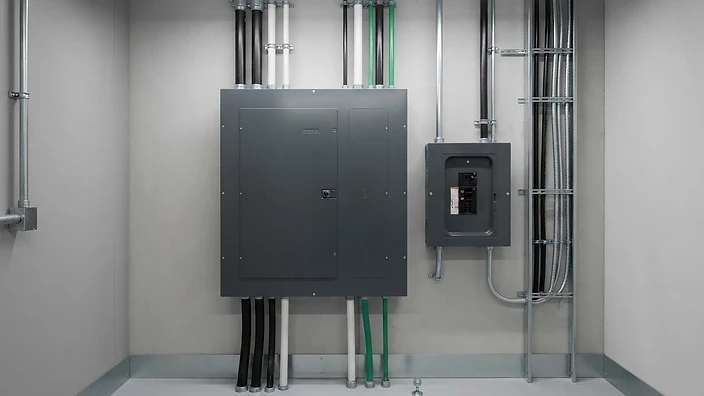
The Physics of Sauna Electrical Load
A premium outdoor sauna heater draws between 6.8 kW and 9.0 kW at full operation. On a standard 110V/15A household circuit, the maximum safe continuous load is approximately 1,440 watts (80% of 1,800W). Your sauna needs 5 to 6 times that.
This isn't a recommendation — it's physics. When a 9kW heater on a shared circuit reaches temperature, it will trip the breaker. Every time. There is no workaround.
The math is straightforward: watts divided by volts equals amps. A 9kW heater at 240V draws 37.5 amps. A 6.8kW heater draws 28.3 amps. Both exceed what any standard household receptacle can deliver. The National Electrical Code requires that continuous loads (anything running 3+ hours, which a sauna session easily does) be calculated at 125% of rated load — so that 37.5A draw actually requires a circuit rated for 47A, which is why a 40A breaker with #8 AWG wire isn't enough for a 9kW unit and you're pushed to a 50A circuit with #6 AWG conductors.
What "Dedicated Circuit" Means
A dedicated circuit is a breaker in your electrical panel that serves exactly one load — your sauna heater. Nothing else shares it. Not the outdoor lights. Not the garage. Not the hot tub.
For most premium saunas, this means:
- 220V/30AMP for heaters up to 6kW (#10 AWG wire)
- 220V/40AMP for heaters up to 7.5kW (#8 AWG wire)
- 220V/50AMP for heaters up to 9kW (#6 AWG wire)
- GFCI protection is required for all outdoor installations per NEC 680
Wire Sizing and Voltage Drop
Wire gauge isn't just about ampacity — it's about distance. Voltage drop becomes a real problem on long runs from the panel to an outdoor installation. The NEC recommends keeping voltage drop under 3% for branch circuits.
At 75 feet, a 40A circuit on #8 AWG copper loses roughly 2.8% — acceptable. At 150 feet, the same wire loses 5.6%, which means your 9kW heater is now receiving only 8.5kW. It will still heat, but recovery time increases and the element works harder, shortening its lifespan.
The fix is upsizing: #6 AWG for runs over 100 feet, or #4 AWG for runs over 150 feet. Your electrician should calculate this, not guess. Ask for the voltage drop calculation on the work order.
GFCI: Non-Negotiable for Outdoor Installations
A Ground Fault Circuit Interrupter detects current leakage as small as 4-6 milliamps and trips in under 25 milliseconds. For any outdoor electrical installation, this is required by code — not optional.
The GFCI can be a breaker in the panel or a receptacle at the sauna, but for a hardwired heater, it's almost always a GFCI breaker. These cost $40-120 more than a standard breaker and occasionally experience nuisance tripping in high-humidity environments. If your sauna trips the GFCI repeatedly, the likely culprit is moisture ingress at the heater connection — not a faulty breaker.
Panel Assessment
Before purchasing, you need to know:
- Available breaker space — Do you have two adjacent slots in your panel for a 2-pole breaker?
- Total load capacity — Is your 200A service already near capacity with existing loads (EV charger, hot tub, AC)?
- Distance to installation site — Wire runs over 75 feet may require upsized conductors to prevent voltage drop.
- Service entrance rating — Older homes with 100A service often cannot support a sauna without a service upgrade.
If your panel is full or your service is undersized, you'll need a sub-panel or service upgrade. Budget $800-$2,500 for this work depending on complexity. A sub-panel near the installation point also solves the voltage drop problem by shortening the high-amperage run.
Permitting and Inspection
Most jurisdictions require an electrical permit for a new dedicated circuit, and an inspection before the circuit can be energized. This is to your advantage — the inspector verifies the wire sizing, GFCI, and grounding are correct before your heater is connected.
Your electrician should pull the permit. If they suggest skipping it, find a different electrician. An uninspected outdoor electrical installation is a liability if you ever sell the home, and it's a safety risk for your family.
The Concierge Advantage
This is exactly why we don't do one-click checkout without guidance. Our concierge can review your panel photo and existing load schedule to verify compatibility before you commit to a purchase. We'd rather catch a panel issue now than after a $12,000 sauna is sitting in your driveway.
Need a panel assessment? Open the concierge and share a photo of your breaker panel.
Need site-specific guidance?