Design · 10 min read
Barrel vs. Cabin Saunas: Which Geometry Is Right for Your Site
The choice between a barrel and cabin sauna isn't just aesthetic — it affects thermal efficiency, seating capacity, maintenance, and where you can actually place it.
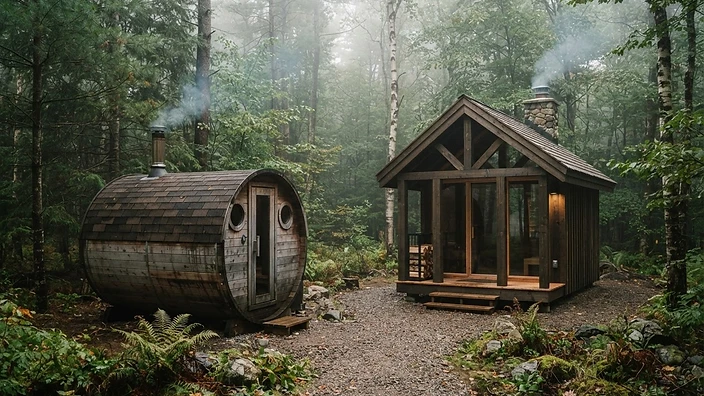
The Thermal Argument for Barrels
A barrel sauna's cylindrical geometry eliminates corner thermal bridging — the weak points where heat escapes in square structures. In independent testing, barrel saunas retain heat 25-30% more efficiently than equivalent-volume cabins.
This means faster heat-up times and lower operating costs. A typical barrel sauna reaches 80°C (176°F) in 35-45 minutes, while a comparable cabin may take 50-70 minutes. Over a decade of regular use, that difference compounds into meaningful electricity savings.
The trade-off is seating: barrel interiors are curved, which some users find less comfortable for extended sessions. The upper bench in a barrel is typically lower than in a cabin, which changes the löyly (steam) experience — in a cabin, the bather sits higher where heat concentrates; in a barrel, the heat distribution is more uniform but the peak temperature zone is less pronounced.
The Architectural Argument for Cabins
Cabin saunas offer:
- Flat walls — easier to mount accessories, shelving, lighting, and towel hooks
- Vertical seating — full-height benches for upright posture (the traditional Finnish position)
- Porch options — many cabin models include covered entries for wood storage and weather protection
- Visual integration — a cabin reads as architecture, not equipment, and can be designed to complement your home's aesthetic
- Insulation cavity — the wall cavity in a cabin allows for additional insulation, which can improve cold-weather performance in extreme climates
Wood Performance by Geometry
Both geometries use the same wood species — typically Canadian Hemlock or Western Red Cedar — but they perform differently.
Barrels rely on wood's natural flexibility. The staves are kerf-cut and bent into the cylindrical shape, which means the wood is under constant tension. In dry climates, this can lead to stave separation if the wood loses moisture. Regular oiling (once or twice per year) is essential to maintain dimensional stability.
Cabins use dimensional lumber joined at right angles. The wood isn't under tension, so it's more dimensionally stable across humidity changes. However, the corner joints are thermal bridges and potential leak points — look for interlocking corner joinery (like dovetail or tongue-and-groove) rather than simple butt joints.
Heating System Differences
Barrel saunas almost exclusively use electric heaters with rocks, since the cylindrical shape doesn't accommodate a full-width wood stove safely. Cabin saunas can be configured for either electric or wood-fired heating.
If you're considering wood-fired, a cabin is your only realistic option between the two. Wood-fired saunas require a chimney, clearance from combustible surfaces, and a non-combustible floor protection pad — all of which are easier to engineer into a square footprint.
Site Considerations
Barrels require a level circular pad and tolerate unsheltered exposure well. Their shape sheds snow and rain naturally. A barrel on a properly rated deck is structurally efficient because the load is distributed around the circumference.
Cabins benefit from a sheltered position or integrated landscaping. The flat roof of some models can accumulate snow — verify the roof load rating if you're in a snow zone. A cabin's rectangular footprint is easier to tuck against a fence line or building wall.
Maintenance Over Time
| Task | Barrel | Cabin | |---|---|---| | Wood oiling | 1-2x per year | 1x per year | | Stave/board replacement | Individual staves can be swapped | Requires disassembly of affected wall | | Roof sealing | N/A (no roof) | Annual check of flashing/sealant | | Bench refinishing | Every 2-3 years | Every 2-3 years | | Snow management | Self-shedding | Manual removal recommended |
The Decision Framework
| Factor | Barrel | Cabin | |---|---|---| | Heat efficiency | Superior | Standard | | Heat-up time | 35-45 min | 50-70 min | | Seating comfort | Good | Excellent | | Visual integration | Sculptural | Architectural | | Snow load | Self-shedding | Verify rating | | Wood-fired option | No | Yes | | Price range | $10-14k | $12-18k |
There is no wrong answer — only the answer that fits your site, your usage pattern, and your visual priorities. If you want maximum thermal efficiency and a striking sculptural presence, the barrel wins. If you want traditional seating, future wood-fired flexibility, and architectural integration, the cabin wins.
Still deciding? Our concierge can review your site photos and recommend the right geometry for your space.
Need site-specific guidance?