Thermal Engineering · 11 min read
Cold Plunge Chiller Sizing: Matching BTU Output to Tub Volume and Climate
An undersized chiller runs continuously, never hits target temp, and dies early. An oversized chiller short-cycles and wastes power. Here is the math that gets it right.
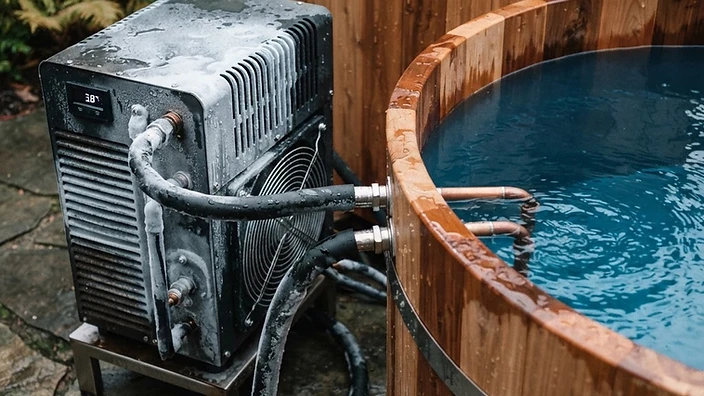
The sizing problem nobody explains
A cold plunge chiller is a refrigeration unit that removes heat from water. The heat it must remove comes from three sources: the water itself (cooling it down to target), the tub's surroundings (heat leaking in through insulation and surface), and the user's body (dumping ~350 BTU/hr into the water during a plunge).
A chiller that can't keep up runs continuously, never reaches target temperature in summer, and compressors that never cycle off die young. A chiller that's wildly oversized cools fast but short-cycles — turning on and off every few minutes — which is hard on the compressor and wastes energy. The goal is a unit that reaches target in 2–4 hours from tap-temp and then cycles at 30–50% duty in steady state.
The three numbers you need
1. Tub volume (gallons)
This is non-negotiable. A 100-gallon tub needs roughly twice the cooling capacity of a 50-gallon tub to hit the same pull-down time. Measure the tub's internal dimensions and calculate: gallons = (length × width × depth in inches) ÷ 231.
2. Target temperature and ambient swing
Most plunges target 39–50°F. The harder number is your summer ambient — the temperature of the air and ground surrounding the tub at its hottest. A plunge in a shaded Minnesota basement has a 20°F ambient swing. The same plunge on a full-sun Arizona patio has a 60°F swing. The chiller must overcome that delta continuously.
3. Insulation value
An uninsulated tub loses (or gains) heat rapidly. A tub with 2 inches of closed-cell foam and a tight lid loses 1–2°F per day in steady state. The chiller sizing changes dramatically between these two.
The rule of thumb (and when to ignore it)
The widely circulated rule is 1/3 HP per 100 gallons. This is a starting point, not a specification. It assumes:
- A reasonably insulated tub (R-10 or better)
- Moderate climate (summer ambient under 90°F)
- Target temp 45°F or warmer
- Shaded installation
If any of those assumptions break, you need more. Specifically:
- Full sun exposure: add 25–40%
- Summer ambient over 95°F: add 40–60%
- Target temp below 40°F: add 20–30% (lower target = harder work, non-linear)
- Uninsulated or thin-walled tub: add 50% minimum, or insulate the tub first — it's cheaper than the chiller upgrade
Worked example
A 80-gallon insulated tub, shaded, in a temperate climate, targeting 45°F:
- Base: 80 gal × (1/3 HP / 100 gal) = 0.27 HP → round to 1/3 HP unit
- Shaded, temperate, insulated: no modifiers
- Spec: 1/3 HP (≈ 4,000 BTU/hr)
The same tub, full sun, in a climate that hits 100°F, targeting 39°F:
- Base: 0.27 HP
- Full sun: +30% → 0.35 HP
- High ambient: +50% → 0.53 HP
- Low target: +25% → 0.66 HP
- Spec: 2/3 HP (≈ 8,000 BTU/hr) minimum, 1 HP for headroom
Why headroom matters
Chillers are rated at specific conditions (usually 95°F ambient, 50°F water). As ambient rises and target drops, actual capacity falls below the nameplate. A unit sized exactly to the calculated load will work in May and struggle in August. Sizing with 15–20% headroom costs a few hundred dollars upfront and prevents the most common support call we see: "it worked great until July."
The features that actually matter
- Titanium heat exchanger. Required for any tub using chlorine, bromine, or salt. Cupronickel is acceptable for ozone-only systems. Aluminum will corrode in weeks.
- Variable-speed compressor or inverter drive. Eliminates short-cycling on oversized units and improves efficiency 20–30%. Worth the premium.
- Active cooling, not just a pump. Some "chillers" are circulation pumps with a filter — they do not refrigerate. Confirm the unit has a compressor and refrigerant loop.
- External temperature probe. Measures water temp, not chiller-side temp. The two differ by several degrees under load.
- Weatherproof rating. Outdoor units need IPX4 minimum. Indoor units in an outdoor enclosure will fail.
Maintenance that affects sizing
A chiller sized correctly will underperform if the filter is clogged or the tub is in full sun with no lid. The lid is the single most important efficiency lever — an uncovered tub loses 4–8°F/day to evaporation and radiation; a covered tub loses 1–2°F. If your chiller seems undersized in summer, check the lid seal before calling support.
The honest summary
Sizing a chiller is a thermal engineering problem, not a product catalog lookup. If you tell us your tub volume, target temp, zip code, and sun exposure, we'll run the numbers and tell you what you need — including whether the tub you're considering is even viable in your climate. Some combinations simply don't work, and no chiller will fix an uninsulated tub in full sun at 105°F.
Need site-specific guidance?