Electrical · 10 min read
GFCI and Dedicated Circuits: What Your Electrician Needs to Know Before Delivery
Your sauna heater draws 24–40 amps continuously for an hour. It cannot share a circuit with anything else, and it must be GFCI-protected. Here is the spec to hand your electrician.
Why this guide exists
More sauna installations fail at the electrical step than at every other step combined. The unit arrives, the customer calls an electrician, and the electrician discovers the panel is full, the run is too long, or the spec they were given is wrong. This guide is the brief you hand your electrician before the unit ships, so the electrical is ready when the sauna arrives.
The non-negotiables
Every electric sauna heater and every cold plunge chiller requires:
- A dedicated circuit. No sharing with outlets, lights, or other appliances. The breaker is labeled and serves only the sauna.
- GFCI protection. A GFCI breaker or a GFCI disconnect at the unit. This is code (NEC 680 and 422) for any heating appliance in a wet or damp location, which an outdoor sauna always is.
- Correct voltage and amperage. The heater's nameplate tells you. Most residential outdoor saunas are 240V / 30–40A. Infrared cabins are often 120V / 15–20A. Chillers are typically 120V / 15A but larger units are 240V / 20A.
- Wire sized to the run. Voltage drop over a long run means the heater underperforms and the breaker trips. The wire gauge must account for both the ampacity and the distance.
The spec sheet to hand your electrician
Give them this, plus the heater's spec sheet from the supplier:
| Heater size | Voltage | Breaker | Wire (≤ 50 ft) | Wire (50–100 ft) | Wire (> 100 ft) | |---|---|---|---|---|---| | 6 kW | 240V | 30A 2-pole GFCI | 10 AWG copper | 8 AWG copper | 6 AWG copper | | 8 kW | 240V | 40A 2-pole GFCI | 8 AWG copper | 6 AWG copper | 6 AWG copper | | 9–10.8 kW | 240V | 50A 2-pole GFCI | 6 AWG copper | 6 AWG copper | 4 AWG copper |
Infrared cabins (120V): 15A or 20A dedicated circuit, 12 AWG (20A) or 14 AWG (15A), standard GFCI breaker.
Cold plunge chillers: check the nameplate. Most are 120V/15A on a standard dedicated GFCI receptacle. 1 HP+ chillers are often 240V/20A.
Panel capacity
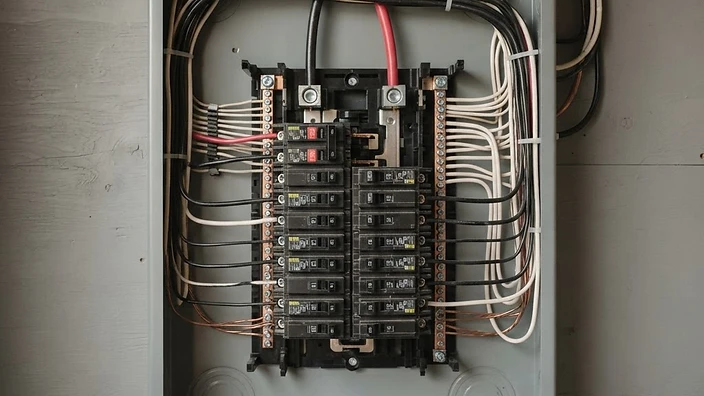
Before anything else, your electrician must confirm the panel has the physical space (two empty adjacent slots for a 2-pole breaker) and the capacity (load calculation headroom) for the new circuit.
A 200A service almost always has room. A 100A service often does not — a 40A sauna circuit on a 100A panel can push the calculated load over the service size, especially with an EV charger, tankless water heater, or mini-split already on the panel. Your electrician does a load Calculation per NEC 220; if the result is within 80% of the service size, you need a service upgrade or a sub-panel.
The sub-panel option
If the main panel is full or too far from the sauna, a sub-panel is often the right move. A 60A or 100A sub-panel fed from the main panel, located near the sauna, gives you a clean place for the GFCI breaker and room for the chiller circuit too. Sub-panels add $400–800 to the job but solve space and distance problems elegantly.
The GFCI question
There are two ways to provide GFCI protection:
- GFCI breaker in the panel. Clean, single-point protection, and the most common approach. The breaker itself is GFCI-rated (it has a test button).
- Standard breaker + GFCI disconnect at the unit. A 2-pole GFCI disconnect (a small weatherproof box with a switch and GFCI) mounted within sight of the sauna. This is required if the run is long and you want the GFCI at the point of use, or if the panel is indoors and the sauna is outdoors and you want a local shutoff.
Either is code-compliant. The local disconnect has the advantage of a visible, accessible shutoff at the sauna — which some inspectors require. Ask your electrician which your jurisdiction prefers.
The run: conduit, burial, and distance
- Indoor runs in finished walls: NM-B (Romex) is acceptable if the wall is dry. In a damp basement or garage, use MC cable or conduit with THHN.
- Outdoor / underground runs: must be in conduit. PVC schedule 40 is standard; direct-bury UF cable is allowed but not recommended (it's hard to replace). Minimum burial depth is 24 inches per NEC 300.5 (18 inches if GFCI-protected, which yours is).
- Distance and voltage drop: the table above accounts for this, but the rule is: at 100+ feet, step up one wire size. At 200+ feet, step up two sizes. Undersized wire on a long run is the #1 cause of "heater trips after 20 minutes" service calls.
What to do, in order
- Before ordering the sauna: have an electrician do a load calculation and confirm panel capacity. If you need a service upgrade or sub-panel, schedule it before the unit arrives.
- When you order: get the heater spec sheet from us and hand it to your electrician. Confirm the breaker size, wire gauge, and GFCI approach.
- Two weeks before delivery: the electrical should be roughed in — conduit run, wire pulled, box at the sauna location. The breaker is installed last, after the unit is placed and the heater is wired.
- At delivery: the white-glove crew places and assembles the unit. Your electrician makes the final connection at the heater and the GFCI disconnect, tests, and signs off.
The cost reality
A straightforward 240V/40A dedicated circuit with GFCI, run 30 feet from a panel with room, is typically $400–700 in most US markets. A sub-panel adds $400–800. A service upgrade (100A to 200A) is $1,500–3,500. These are not optional costs — they are the cost of a safe, code-compliant outdoor sauna. Budget for them before you buy the unit.
Our concierge can review your panel photo and heater spec and tell you what you're likely looking at before you call an electrician. We can't do the work, but we can make sure you walk into the electrician's estimate already knowing what the job should be.
Need site-specific guidance?