Logistics · 8 min read
Residential Freight Delivery: Liftgate Requirements and Access Constraints Explained
A sauna arrives on a 53-foot truck weighing 30,000 lb. It cannot turn around in your cul-de-sac and the driver will not carry it up your steps. Here is how to make delivery actually work.
What 'freight delivery' actually means
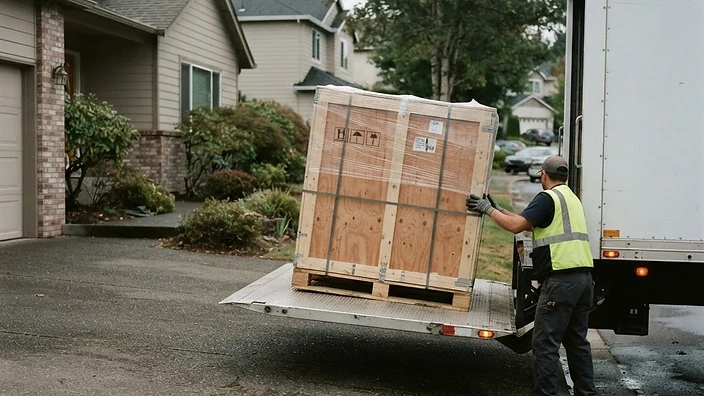
Saunas and cold plunge chillers ship LTL (less-than-truckload) freight on pallets. The truck that arrives is a Class 8 semi — 53 feet long, 30,000+ lb empty, with a turning radius that excludes most residential driveways. The driver is a freight driver, not a mover. They will position the truck, lower the pallet to the ground with a liftgate, and that is where their responsibility ends.
Understanding this before delivery day is the difference between a smooth placement and a unit stranded at the curb.
The four delivery tiers
Curbside with liftgate (standard)
The pallet is lowered to the ground at the end of your driveway or the nearest point the truck can safely reach. From there, it is yours to move. This is the default tier included with most sauna shipments.
What you need: a clear, level area at the curb where the pallet can be set down without blocking traffic, and 2–4 adults to move it from there to the install site.
Threshold / garage delivery
The driver moves the pallet to your garage or front porch. This requires a pallet jack (the driver carries one) and a flat, paved path from the truck to the threshold. Stairs, gravel, and slopes defeat the pallet jack.
Surcharge: typically $50–150. Worth it if your garage is accessible.
Inside / room-of-choice
The unit is moved inside the home to the installation room. This is almost never available for sauna freight — the pallets are too large for interior doors and the liability is too high. If you need this, you're in white-glove territory (see below).
White-glove / placement & assembly
A two-person crew receives the unit, uncrates it, carries it to the install site, assembles it, levels it, and removes the crate and pallet. This is the $1,900 service we offer. It does not include electrical or plumbing connection — those are separate trades.
The access constraints that cause 90% of delivery problems
Driveway and street access
- Cul-de-sacs and dead ends. A 53-foot truck cannot back out of a tight cul-de-sac. It must be able to drive through or back in. If your street is a dead end, the truck will stop at the entrance and the pallet goes at the curb there — potentially 100+ feet from your door.
- Gravel driveways. Pallet jacks do not roll on gravel. If your driveway is gravel, the pallet stops at the paved road.
- Sloped driveways. A pallet jack on a slope is a runaway hazard. Drivers will refuse to jack a pallet down anything over a gentle grade.
- Overhead clearance. Low-hanging branches, power lines, and awnings prevent the truck from reaching you. The truck is 13.5 feet tall.
Path from curb to install site
- Stairs. A sauna crate is 300–600 lb. Two people can carry it up a few steps. More than three steps and you need a crew of four or a white-glove team.
- Gates and fence clearances. A standard sauna crate is 48 inches wide. A 36-inch side gate will not pass it. Measure before delivery.
- Soft ground. The pallet jack needs pavement. Grass, mud, and garden beds are impassable.
The crate itself
Uncrate the unit at the curb and carry the components individually if the full crate can't make the path. A barrel sauna's staves are manageable; a cabin sauna's panels are large but flat. The heater is the heaviest single piece — a 6 kW Harvia stove is 40–60 lb; an 8 kW is 70–90 lb. Plan for the heater's weight and size when routing the carry.
The pre-delivery checklist
Two weeks before delivery, the freight carrier will call to schedule. Before that call, confirm:
- [ ] The truck can physically reach your address (check street type, turning room, overhead clearance)
- [ ] You know where the pallet will be set down
- [ ] You have a plan and enough people to move it from there to the install site
- [ ] The path from set-down to install site is clear, paved, and wide enough
- [ ] If any of the above is uncertain, you've arranged white-glove service or a local mover
When to choose white-glove
If you have stairs, a gravel driveway, a tight gate, or simply don't have four able adults on delivery day, white-glove placement & assembly is the right call. The crew handles the freight interface, the carry, the uncrating, the assembly, and the debris — and you don't spend a Saturday wrestling a 500 lb crate.
What white-glove does not cover: electrical connection, panel work, dedicated circuit installation, and for cold plunges, plumbing and drain connections. Those require a licensed electrician and, where applicable, a plumber. We coordinate the white-glove team; you coordinate the trades. Our concierge can help you source both in your region.
Need site-specific guidance?