Electrical · 11 min read
Electrical Fitment Before You Buy: What Your Home Needs to Carry
The heater, not the cabin, decides your electrical requirement. The costly surprises — a 208V building, a full panel, a trench through finished landscaping — are all decided before delivery. Here is what to verify, and what to hand your electrician.
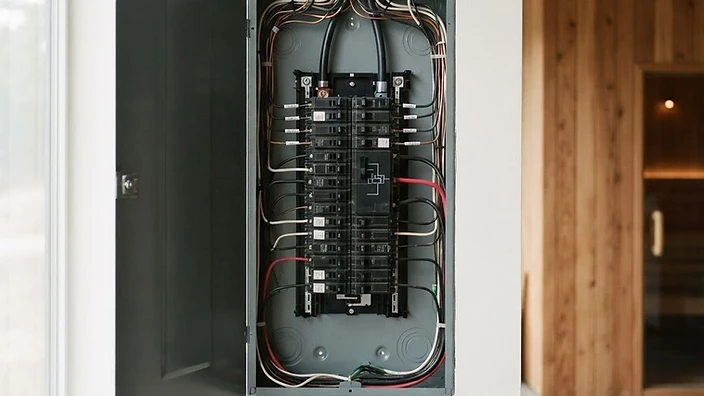
Fitment is a pre-purchase question
The most expensive surprise in a sauna project is not the sauna. It is discovering, the week the freight arrives, that your panel cannot carry the heater you chose — or that your service is 208V three-phase rather than 240V, or that the run from the panel to the unit needs a trench through finished landscaping.
None of those are installation problems. They are fitment problems, and every one of them is decided before you order.
This guide covers the four checks that determine whether a specific unit and heater will work in your specific home, plus the published electrical requirement for every model we carry. The general principles here are planning guidance for your conversation with an electrician. The governing document for any installation is always the heater manufacturer's manual and nameplate, alongside your local code and your inspector. We do not perform electrical work, and nothing in our delivery or assembly scope energizes a unit.
Check 1: Identify what actually draws the power
The cabin is structure. The heater is the load.
This is why two buyers can order the same cabin and need different circuits. The same model is often offered with a 6 kW heater or a 9 kW heater, and that difference matters more than the cabin's footprint. When you configure a sauna, the heater selection is the electrical decision.
- Read the heater you selected. Its rating in kilowatts and its rated voltage are the two numbers everything else follows from.
- If you have not chosen a heater yet, either choose before your electrician's visit, or plan the circuit around the largest heater that model accepts. Upgrading a circuit later costs far more than running the heavier one once.
- Fixed electric heaters are treated as continuous loads. Under the National Electrical Code your electrician will size the branch circuit above the heater's published rating, typically at 125% of it. That headroom is why "my neighbor ran a 240V line for his" is not a shortcut.
- Wood-burning changes the question entirely. A wood heater needs no electrical supply, but it brings chimney clearances, a floor plate, and a fire-safe wall assembly instead.
Where the number comes from, in order: the heater's nameplate, its manufacturer manual, then our published requirement as a starting point.
Check 2: Read your home's service
Your electrician performs the load calculation. What you gather beforehand saves a visit.
Photograph your panel twice: cover on, for context, and cover off, for the breaker layout. Also photograph the main breaker's amp rating and any label inside the door. Those three photos let a professional tell you most of what they need before setting foot in your house.
- Service size. 100A, 150A, 200A, 400A. Most homes can carry a single sauna heater. Add EV charging, a heat pump, and an induction range and a 100A service gets tight fast.
- Open breaker spaces. A full panel is not automatically a problem — a subpanel is a common, moderate-cost fix — but you want to know before delivery, not after.
- A service upgrade is the expensive outcome. A subpanel often runs a few hundred dollars. A service upgrade can run into the thousands and requires a permit and a utility disconnect. The fitment checks exist to keep this off your critical path.
- Multi-unit buildings are different. In a condo or apartment you may not control the service or the exterior walls. New circuits and conduit runs can require written building approval, which takes time. Start early.
Check 3: Voltage and phase
This is the check buyers skip most often, and the one that causes the most unpleasant surprises.
- 120/240V single-phase is the standard North American residential service. Our catalog lists these as 110V or 220–240V, following the labels our suppliers publish.
- 208V three-phase is what many buildings — condos, apartments, some mixed-use and commercial spaces — actually supply. A heater rated at 240V running on 208V delivers roughly three quarters of its rated output, because power falls with the square of the voltage. The sauna still runs; it heats more slowly and may not hold temperature for the room volume it was rated for. Some heaters are available in voltage-specific versions. If you are in a multi-unit building, ask the question directly: is the supply to my unit 120/240V single-phase, or 208V three-phase?
- 380V three-phase appears in some commercial buildings and outside North America, and several models we carry support it.
- Plug-in is not the same as shareable. Infrared cabins and chillers frequently run from a standard outlet, often on a dedicated circuit that must not be shared with anything else. "It plugs in" does not mean "it can share an outlet." Hardwired heaters need a dedicated circuit, a disconnect, and GFCI protection.
Check 4: Distance, route, and who does what
The distance from your panel to where the unit will sit determines conductor size, conduit, and cost.
- Long runs get expensive. Past a certain distance, voltage drop forces your electrician to upsize conductors. Worth knowing before you compare quotes.
- Outdoor installs mean conduit. A weather-rated connection at the unit, an appropriate disconnect, and GFCI protection are standard expectations. Where the run is underground, the trench has to exist before the pad or deck is finished. If you are pouring a slab, plan the conduit route in the same conversation — our foundation guide covers the site-prep sequence.
- The scope boundary matters. Our White-Glove assembly service, if selected, covers physical placement and assembly only. Electrical connection, GFCI protection, and plumbing or drain commissioning are performed by your licensed electrician and plumber. No one on our delivery crew energizes a sauna or a chiller.
Published requirements by model
These lines mirror what each manufacturer publishes for the model, matched to the listing in our catalog. They are a starting point — the heater's nameplate and manual govern, and your electrician confirms the circuit.
Traditional saunas — electric heater, hardwired
- CT MiniPOD Sauna — electric heater option only, recommended 7.5 kW, dedicated circuit confirmed with your selected heater
- CT Elation Sauna — electric heater option only, recommended 7.5 kW
- CT Luna Sauna — electric heater only, recommended 6 kW
- CT Cabin Sauna — electric heater on every model, recommended 6 kW on Granby and Palmer, 9 kW on Georgian
- CT Barrel Sauna — electric heater option, recommended 6 kW on Harmony, 7.5 kW on Serenity and Tranquility
- CT Avalon Sauna — electric heater option, dedicated circuit confirmed with your selected heater
- CT Element Indoor Sauna — electric heater only, dedicated circuit confirmed with your selected heater
- Auris Two Outdoor Cedar Sauna — 9 kW COASTS heater, 380V, 220–240V, or 110V dedicated circuit; wood-burning on request
- Auris One Outdoor Cedar Sauna — 4.5 kW Harvia KIP heater, 380V, 220–240V, or 110V dedicated circuit; wood-burning option
- Harvia 4.5 kW Heater Add-On — 240V / 30A dedicated circuit
Infrared cabins — plug-in electric
- Lumin Infrared Sauna One — 110V or 220V plug-powered
- Lumin Infrared Sauna Two — 110V or 220V plug-powered
- Lumin Infrared Sauna Three — 110V plug-powered, standard outlet
- Fjordheim Solo Infrared Sauna — 110V / 220–240V / 380V plug-in electric
- Eldvik 2-Person Outdoor Infrared Sauna — plug-in electric, 110V / 220–240V compatible
Cold plunges and chillers
- Orivon Frost Cold Plunge Tub — 110V 60Hz or 220V 50Hz, 12A dedicated circuit
- Aurland Cedar Ice Bath with Chiller — 110V or 220V for the included 1HP chiller, 1000W
- Frostgard Pro Ice Bath Chiller — 110V or 220V, 1000W
- Aurland Cedar Ice Bath — none, manual fill; 110V or 220V if you add the optional chiller
- Isvik Cedar Ice Bath — none, passive cold immersion; chiller sold separately
No electrical supply required
- Starlight Wood Burning Hot Tub — internal wood-burning heater
- Wood-burning heater configurations of the LeisureCraft saunas above — no electrical supply, but the chimney and floor plate steps apply
If a model you are considering does not appear with a requirement above, we do not yet have a verified figure for it. Ask us and we will confirm with the supplier before you commit rather than estimate.
Four fitment surprises that show up late
- The 208V building. A 240V-rated heater on a 208V supply underperforms quietly. Everything "works," and the sauna never quite reaches the temperature you expected.
- A full panel, discovered late. The fix is usually straightforward. The timing is what hurts, because a subpanel has to happen before the unit is placed and wired.
- The trench after the slab. Pouring a pad and finishing landscaping before planning the electrical route turns a modest conduit run into a restoration project.
- The heater you will want next year. Choosing 6 kW today when you may want 9 kW later means a second circuit later. If the run is accessible and the panel has room, size for the heavier heater once.
What to send your electrician
A short brief gets you a real quote instead of a guess:
- The unit model and the heater you selected, or the largest heater the model accepts
- The manufacturer's published electrical requirement for that heater
- Photos of your panel: cover on, cover off, and the main breaker's amp rating
- Where the unit will sit, and the distance and route from the panel to that point
- Whether your supply is 120/240V single-phase or 208V three-phase
- Any HOA, landlord, or building management constraints
Then ask for: a load calculation, whether a subpanel or service upgrade is required, whether a permit is needed and who pulls it, and a written quote covering the dedicated circuit, GFCI protection, the disconnect, conduit and weatherproofing, any trench, and the permit.
Where we come in
Send your panel photos, your electrician's quote, or a simple floor plan. We will match your home's service against the requirement for the exact heater and model you want, confirm the published figure with the supplier where a listing is still unverified, and tell you plainly when a question sits outside what we can answer — electrical work is always your licensed electrician's call.
Related reading
- GFCI and Dedicated Circuits: What Your Electrician Needs to Know Before Delivery
- The 220V Mandate: Why High-Ticket Saunas Require Dedicated Circuits
- Outdoor Sauna Foundation Prep: Concrete Pads, Deck Load Ratings, and Gravel Beds
- Cold Plunge Chiller Sizing: Matching BTU Output to Tub Volume and Climate
Need site-specific guidance?